Loading…
Creator · 道友请留步
View original source ↗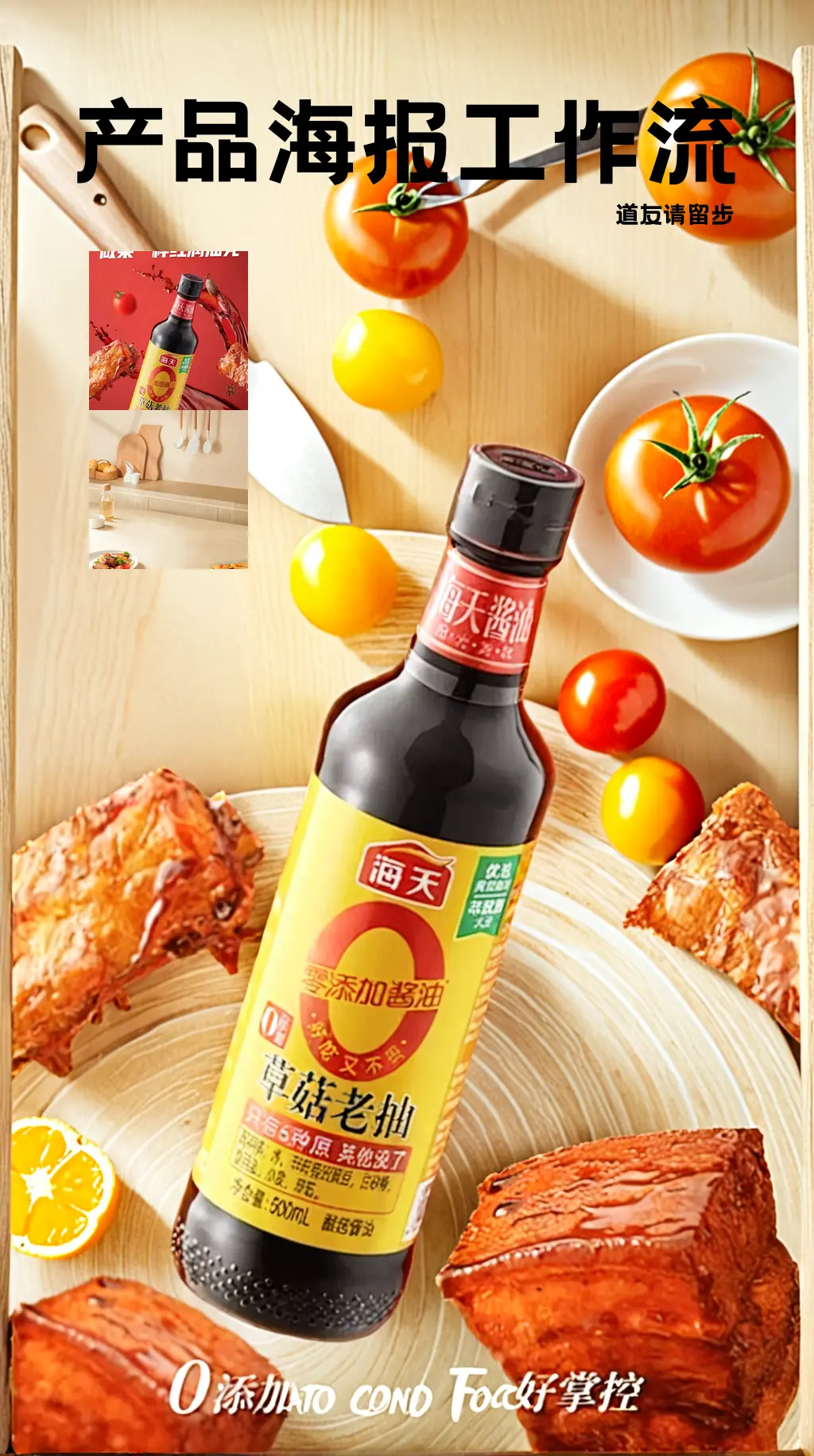
Prompt
Workflow Introduction:
This is a workflow for creating product posters with astonishingly good results. It can completely replicate your product and then reference the style of the background you want to use, combining the two to finally form a beautiful poster.
In our work, we may encounter requirements to create posters and effect displays for a product. The most important thing to note in this requirement is that the product must not change and must blend very naturally with the background image. Of course, if you have advanced PS skills, you can certainly use PS for creation. However, PS is heavily dependent on materials, and if you are not very satisfied with the materials, you can use this workflow to draft your poster.
Workflow Idea:
First, process the product image by resizing it proportionally to a width of 1024, then cut out the product and create a mask for it.
Next, perform prompt inversion on the reference image of the background style.
Then use a combination of brushNET and contronet to blend the product image with the background prompts obtained from the inversion.
By this step, the process is essentially complete. If you are satisfied with the output quality, you can stop the workflow here. To achieve commercial-level quality,
I used FLUX to perform secondary sampling on the composite image.
Then, I used IC Light to adjust the lighting and shadows of the product and background.
Finally, I used FLUX with an upscaling model to enlarge the image to 2048, thus achieving commercial value.
How to Use:
It's very simple to use. From the perspective of running it once, you just need to upload two images: one product image and one background reference image, then click run.
When uploading the product image, please ensure that there is only one product in the image and that the product image is of high quality.
If using locally, please ensure you use the network scientifically to install nodes and models.
If using online, please remember to reselect the model, as the location of models may vary across platforms.
Test with sample images, and after running successfully, you can use your own product and background reference images, then fine-tune the parameters.


First Group


Final Effect


Second Group


Final Effect:


Share

Download
190
Download
5
13

Open AI App
Launch on cloud
Like Favorite
道友请留步
2025-06-01 Update

Follow

Posters

道友请留步
2025-06-01 Update

Follow

Workflow introduction

Workflow Introduction:
This is a workflow for creating product posters with astonishingly good results. It can completely replicate your product and then reference the style of the background you want to use, combining the two to finally form a beautiful poster.
In our work, we may encounter requirements to create posters and effect displays for a product. The most important thing to note in this requirement is that the product must not change and must blend very naturally with the background image. Of course, if you have advanced PS skills, you can certainly use PS for creation. However, PS is heavily dependent on materials, and if you are not very satisfied with the materials, you can use this workflow to draft your poster.
Workflow Idea:
First, process the product image by resizing it proportionally to a width of 1024, then cut out the product and create a mask for it.
Next, perform prompt inversion on the reference image of the background style.
Then use a combination of brushNET and contronet to blend the product image with the background prompts obtained from the inversion.
By this step, the process is essentially complete. If you are satisfied with the output quality, you can stop the workflow here. To achieve commercial-level quality,
I used FLUX to perform secondary sampling on the composite image.
Then, I used IC Light to adjust the lighting and shadows of the product and background.
Finally, I used FLUX with an upscaling model to enlarge the image to 2048, thus achieving commercial value.
How to U
Models & stability
Recommended models
Independent retest evidence
Sep 2, 2026

The requested model is recorded, but the generation receipt did not expose a verifiable underlying model ID.
Aug 9, 2026

The requested model is recorded, but the generation receipt did not expose a verifiable underlying model ID.
Keep exploring

Workflow introduction Remastered from: alansun Workflow source: https://openart.ai/workflows/alansyn/easy product relight/XdzTNRbqi1kMYpNjuFWm Product shadow and light poster drawing based on Brushnet IC Light, convenient and easy to use. By configuring different parameter switches, two mode paths are supported: Basic Mode : Suitable for scenes with simple background elements, controlling the background and light-shadow types through prompts Advanced Mode : Suitable for scenarios requiring more precise control, using precise prompts or style reference images as input, and using brushnet for background redrawing Configuration Parameter Description 1. Basic Prompt : Used to describe the product type, such as 1shoe 2. Light-Shadow Prompt : Used to describe the type of light-shadow, can also add background descriptions, such as sunshine light, river background 3. Product Image : Product mat…
Prompt
Workflow introduction Remastered from: alansun Workflow source: https://openart.ai/workflows/alansyn/easy product relight/XdzTNRbqi1kMYpNjuFWm Product shadow and light poster drawing based on Brushnet IC Light, convenient and easy to use. …

A detailed prompt for generating a whimsical alphabet set in a 1970s graphic style, featuring playful rounded lettering, bold outlines, and bright soft-toned decorations.
Prompt
A collection of alphabet letters, {argument name="letters" default="A through Z"} and decorative elements are arranged in rows against a {argument name="background color" default="

A prompt requesting a specific composition: a photo featuring two people, Sam and Ilya, and a dog. The specified style is “2000s film-camera style,” with the mood “looking very bored at a children’s birthday party.”
Prompt
Combine the two men (Sam & Ilya) and the dog in a 2000s film camera-style photo of them looking bored at a kids birthday party.