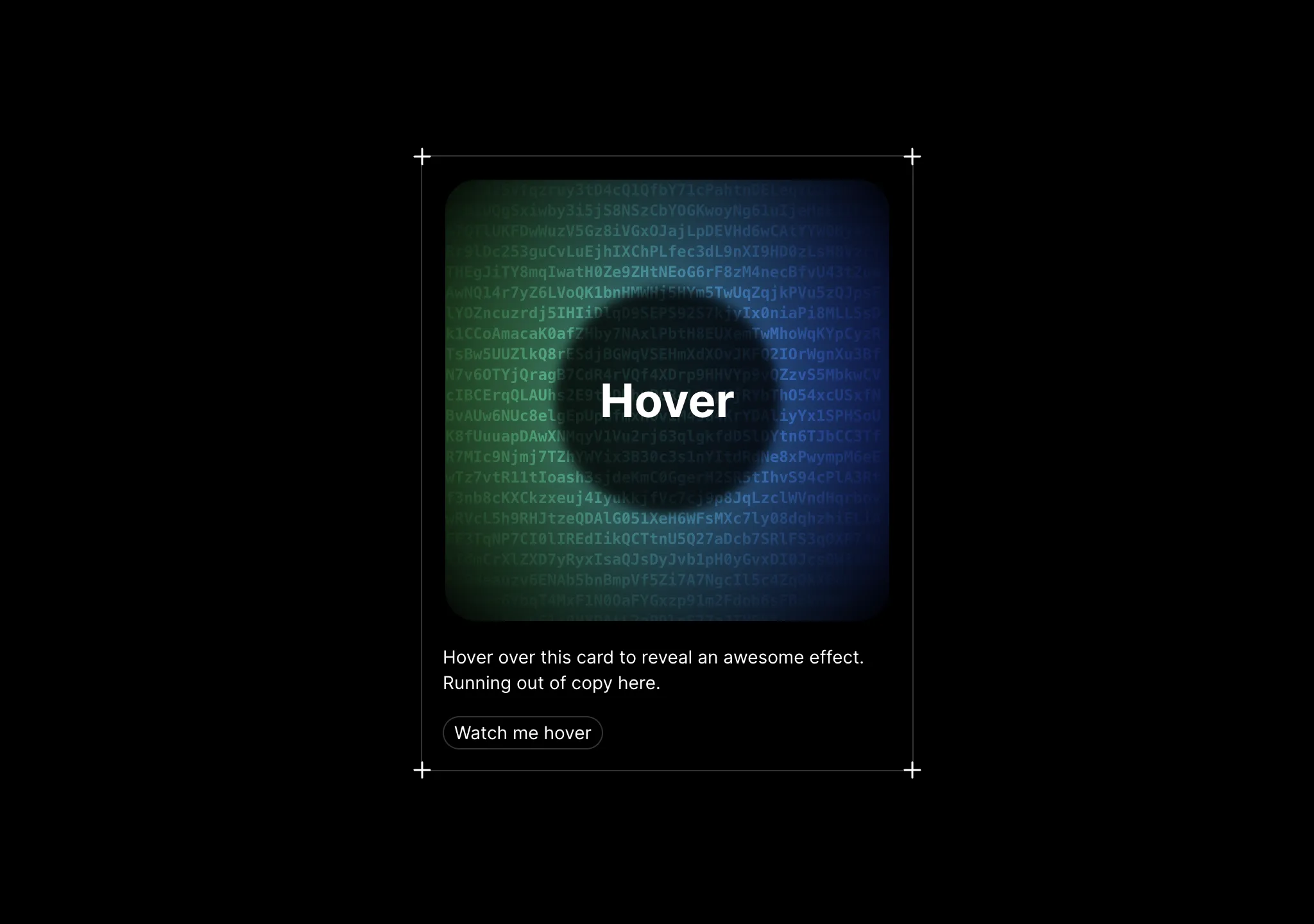


Loading…
Loading…
Creator · Aceternity UI
The reproduction prompt keeps the original and adds runtime, asset and acceptance requirements. These additions are not the author’s words.
// components/ui/card-spotlight.tsx
"use client";

import { useMotionValue, motion, useMotionTemplate } from "motion/react";
import React, { MouseEvent as ReactMouseEvent, useState } from "react";
import { CanvasRevealEffect } from "@/components/ui/canvas-reveal-effect";
import { cn } from "@/lib/utils";

export const CardSpotlight = ({
  children,
  radius = 350,
  color = "#262626",
  className,
  ...props
}: {
  radius?: number;
  color?: string;
  children: React.ReactNode;
} & React.HTMLAttributes<HTMLDivElement>) => {
  const mouseX = useMotionValue(0);
  const mouseY = useMotionValue(0);
  function handleMouseMove({
    currentTarget,
    clientX,
    clientY,
  }: ReactMouseEvent<HTMLDivElement>) {
    let { left, top } = currentTarget.getBoundingClientRect();

    mouseX.set(clientX - left);
    mouseY.set(clientY - top);
  }

  const [isHovering, setIsHovering] = useState(false);
  const handleMouseEnter = () => setIsHovering(true);
  const handleMouseLeave = () => setIsHovering(false);
  return (
    <div
      className={cn(
        "group/spotlight p-10 rounded-md relative border border-neutral-800 bg-black dark:border-neutral-800",
        className
      )}
      onMouseMove={handleMouseMove}
      onMouseEnter={handleMouseEnter}
      onMouseLeave={handleMouseLeave}
      {...props}
    >
      <motion.div
        className="pointer-events-none absolute z-0 -inset-px rounded-md opacity-0 transition duration-300 group-hover/spotlight:opacity-100"
        style={{
          backgroundColor: color,
          maskImage: useMotionTemplate`
            radial-gradient(
              ${radius}px circle at ${mouseX}px ${mouseY}px,
              white,
              transparent 80%
            )
          `,
        }}
      >
        {isHovering && (
          <CanvasRevealEffect
            animationSpeed={5}
            containerClassName="bg-transparent absolute inset-0 pointer-events-none"
            colors={[
              [59, 130, 246],
              [139, 92, 246],
            ]}
            dotSize={3}
          />
        )}
      </motion.div>
      {children}
    </div>
  );
};

// components/ui/canvas-reveal-effect.tsx
"use client";
import { cn } from "@/lib/utils";
import { Canvas, useFrame, useThree } from "@react-three/fiber";
import React, { useMemo, useRef } from "react";
import * as THREE from "three";

export const CanvasRevealEffect = ({
  animationSpeed = 0.4,
  opacities = [0.3, 0.3, 0.3, 0.5, 0.5, 0.5, 0.8, 0.8, 0.8, 1],
  colors = [[0, 255, 255]],
  containerClassName,
  dotSize,
  showGradient = true,
}: {
  /**
   * 0.1 - slower
   * 1.0 - faster
   */
  animationSpeed?: number;
  opacities?: number[];
  colors?: number[][];
  containerClassName?: string;
  dotSize?: number;
  showGradient?: boolean;
}) => {
  return (
    <div className={cn("h-full relative bg-white w-full", containerClassName)}>
      <div className="h-full w-full">
        <DotMatrix
          colors={colors ?? [[0, 255, 255]]}
          dotSize={dotSize ?? 3}
          opacities={
            opacities ?? [0.3, 0.3, 0.3, 0.5, 0.5, 0.5, 0.8, 0.8, 0.8, 1]
          }
          shader={`
              float animation_speed_factor = ${animationSpeed.toFixed(1)};
              float intro_offset = distance(u_resolution / 2.0 / u_total_size, st2) * 0.01 + (random(st2) * 0.15);
              opacity *= step(intro_offset, u_time * animation_speed_factor);
              opacity *= clamp((1.0 - step(intro_offset + 0.1, u_time * animation_speed_factor)) * 1.25, 1.0, 1.25);
            `}
          center={["x", "y"]}
        />
      </div>
      {showGradient && (
        <div className="absolute inset-0 bg-gradient-to-t from-gray-950 to-[84%]" />
      )}
    </div>
  );
};

interface DotMatrixProps {
  colors?: number[][];
  opacities?: number[];
  totalSize?: number;
  dotSize?: number;
  shader?: string;
  center?: ("x" | "y")[];
}

const DotMatrix: React.FC<DotMatrixProps> = ({
  colors = [[0, 0, 0]],
  opacities = [0.04, 0.04, 0.04, 0.04, 0.04, 0.08, 0.08, 0.08, 0.08, 0.14],
  totalSize = 4,
  dotSize = 2,
  shader = "",
  center = ["x", "y"],
}) => {
  const uniforms = React.useMemo(() => {
    let colorsArray = [
      colors[0],
      colors[0],
      colors[0],
      colors[0],
      colors[0],
      colors[0],
    ];
    if (colors.length === 2) {
      colorsArray = [
        colors[0],
        colors[0],
        colors[0],
        colors[1],
        colors[1],
        colors[1],
      ];
    } else if (colors.length === 3) {
      colorsArray = [
        colors[0],
        colors[0],
        colors[1],
        colors[1],
        colors[2],
        colors[2],
      ];
    }

    return {
      u_colors: {
        value: colorsArray.map((color) => [
          color[0] / 255,
          color[1] / 255,
          color[2] / 255,
        ]),
        type: "uniform3fv",
      },
      u_opacities: {
        value: opacities,
        type: "uniform1fv",
      },
      u_total_size: {
        value: totalSize,
        type: "uniform1f",
      },
      u_dot_size: {
        value: dotSize,
        type: "uniform1f",
      },
    };
  }, [colors, opacities, totalSize, dotSize]);

  return (
    <Shader
      source={`
        precision mediump float;
        in vec2 fragCoord;

        uniform float u_time;
        uniform float u_opacities[10];
        uniform vec3 u_colors[6];
        uniform float u_total_size;
        uniform float u_dot_size;
        uniform vec2 u_resolution;
        out vec4 fragColor;
        float PHI = 1.61803398874989484820459;
        float random(vec2 xy) {
            return fract(tan(distance(xy * PHI, xy) * 0.5) * xy.x);
        }
        float map(float value, float min1, float max1, float min2, float max2) {
            return min2 + (value - min1) * (max2 - min2) / (max1 - min1);
        }
        void main() {
            vec2 st = fragCoord.xy;
            ${
              center.includes("x")
                ? "st.x -= abs(floor((mod(u_resolution.x, u_total_size) - u_dot_size) * 0.5));"
                : ""
            }
            ${
              center.includes("y")
                ? "st.y -= abs(floor((mod(u_resolution.y, u_total_size) - u_dot_size) * 0.5));"
                : ""
            }
      float opacity = step(0.0, st.x);
      opacity *= step(0.0, st.y);

      vec2 st2 = vec2(int(st.x / u_total_size), int(st.y / u_total_size));

      float frequency = 5.0;
      float show_offset = random(st2);
      float rand = random(st2 * floor((u_time / frequency) + show_offset + frequency) + 1.0);
      opacity *= u_opacities[int(rand * 10.0)];
      opacity *= 1.0 - step(u_dot_size / u_total_size, fract(st.x / u_total_size));
      opacity *= 1.0 - step(u_dot_size / u_total_size, fract(st.y / u_total_size));

      vec3 color = u_colors[int(show_offset * 6.0)];

      ${shader}

      fragColor = vec4(color, opacity);
      fragColor.rgb *= fragColor.a;
        }`}
      uniforms={uniforms}
      maxFps={60}
    />
  );
};

type Uniforms = {
  [key: string]: {
    value: number[] | number[][] | number;
    type: string;
  };
};
const ShaderMaterial = ({
  source,
  uniforms,
  maxFps = 60,
}: {
  source: string;
  hovered?: boolean;
  maxFps?: number;
  uniforms: Uniforms;
}) => {
  const { size } = useThree();
  const ref = useRef<THREE.Mesh>();
  let lastFrameTime = 0;

  useFrame(({ clock }) => {
    if (!ref.current) return;
    const timestamp = clock.getElapsedTime();
    if (timestamp - lastFrameTime < 1 / maxFps) {
      return;
    }
    lastFrameTime = timestamp;

    const material: any = ref.current.material;
    const timeLocation = material.uniforms.u_time;
    timeLocation.value = timestamp;
  });

  const getUniforms = () => {
    const preparedUniforms: any = {};

    for (const uniformName in uniforms) {
      const uniform: any = uniforms[uniformName];

      switch (uniform.type) {
        case "uniform1f":
          preparedUniforms[uniformName] = { value: uniform.value, type: "1f" };
          break;
        case "uniform3f":
          preparedUniforms[uniformName] = {
            value: new THREE.Vector3().fromArray(uniform.value),
            type: "3f",
          };
          break;
        case "uniform1fv":
          preparedUniforms[uniformName] = { value: uniform.value, type: "1fv" };
          break;
        case "uniform3fv":
          preparedUniforms[uniformName] = {
            value: uniform.value.map((v: number[]) =>
              new THREE.Vector3().fromArray(v)
            ),
            type: "3fv",
          };
          break;
        case "uniform2f":
          preparedUniforms[uniformName] = {
            value: new THREE.Vector2().fromArray(uniform.value),
            type: "2f",
          };
          break;
        default:
          console.error(`Invalid uniform type for '${uniformName}'.`);
          break;
      }
    }

    preparedUniforms["u_time"] = { value: 0, type: "1f" };
    preparedUniforms["u_resolution"] = {
      value: new THREE.Vector2(size.width * 2, size.height * 2),
    }; // Initialize u_resolution
    return preparedUniforms;
  };

  // Shader material
  const material = useMemo(() => {
    const materialObject = new THREE.ShaderMaterial({
      vertexShader: `
      precision mediump float;
      in vec2 coordinates;
      uniform vec2 u_resolution;
      out vec2 fragCoord;
      void main(){
        float x = position.x;
        float y = position.y;
        gl_Position = vec4(x, y, 0.0, 1.0);
        fragCoord = (position.xy + vec2(1.0)) * 0.5 * u_resolution;
        fragCoord.y = u_resolution.y - fragCoord.y;
      }
      `,
      fragmentShader: source,
      uniforms: getUniforms(),
      glslVersion: THREE.GLSL3,
      blending: THREE.CustomBlending,
      blendSrc: THREE.SrcAlphaFactor,
      blendDst: THREE.OneFactor,
    });

    return materialObject;
  }, [size.width, size.height, source]);

  return (
    <mesh ref={ref as any}>
      <planeGeometry args={[2, 2]} />
      <primitive object={material} attach="material" />
    </mesh>
  );
};

const Shader: React.FC<ShaderProps> = ({ source, uniforms, maxFps = 60 }) => {
  return (
    <Canvas className="absolute inset-0  h-full w-full">
      <ShaderMaterial source={source} uniforms={uniforms} maxFps={maxFps} />
    </Canvas>
  );
};
interface ShaderProps {
  source: string;
  uniforms: {
    [key: string]: {
      value: number[] | number[][] | number;
      type: string;
    };
  };
  maxFps?: number;
}Models & stability
Recommended models
Independent reproductions
 Open reproduction ↗
GLM-5.3 单次生成;Codex 人工修复运行依赖、必要源码及移动布局,未重新生成。桌面/手机真实渲染和资源检查通过;完整功能与视觉还原尚未全部验收。源码、截图和修复记录见复现出处。
Reproduction source ↗Keep exploring

Copy this TSX component source into an AI coding tool such as Cursor, v0, or Claude, and tell it this is the Aceternity UI 3D Animated Pin component. It can then wire it into your React project, and you can swap the copy, colors, and trigger parameters to reuse it.
Prompt
// components/ui/3d-pin.tsx "use client"; import React, { useState } from "react"; import { motion } from "motion/react"; import { cn } from "@/lib/utils"; export const PinContainer = ({ children, title, href, className, containerClassName…

Copy this TSX component source into an AI coding tool such as Cursor, v0, or Claude, and tell it this is the Aceternity UI 3D Globe component. It can then wire it into your React project, and you can swap the copy, colors, and trigger parameters to reuse it.
Prompt
// components/ui/3d-globe.tsx "use client"; import React, { useRef, useMemo, useState, useCallback, Suspense } from "react"; import { Canvas, useFrame, useThree } from "@react-three/fiber"; import { OrbitControls, Html, useTexture } from "…

Copy this TSX component source into an AI coding tool such as Cursor, v0, or Claude, and tell it this is the Aceternity UI 3D Marquee component. It can then wire it into your React project, and you can swap the copy, colors, and trigger parameters to reuse it.
Prompt
// components/ui/3d-marquee.tsx "use client"; import { motion } from "motion/react"; import { cn } from "@/lib/utils"; export const ThreeDMarquee = ({ images, className, }: { images: string[]; className?: string; }) => { // Split the image…
Same creator
Each detail page keeps the original result, the prompt, and retest evidence in one reading path.